
Using AI for Investment Portfolio Review: A Practical Guide
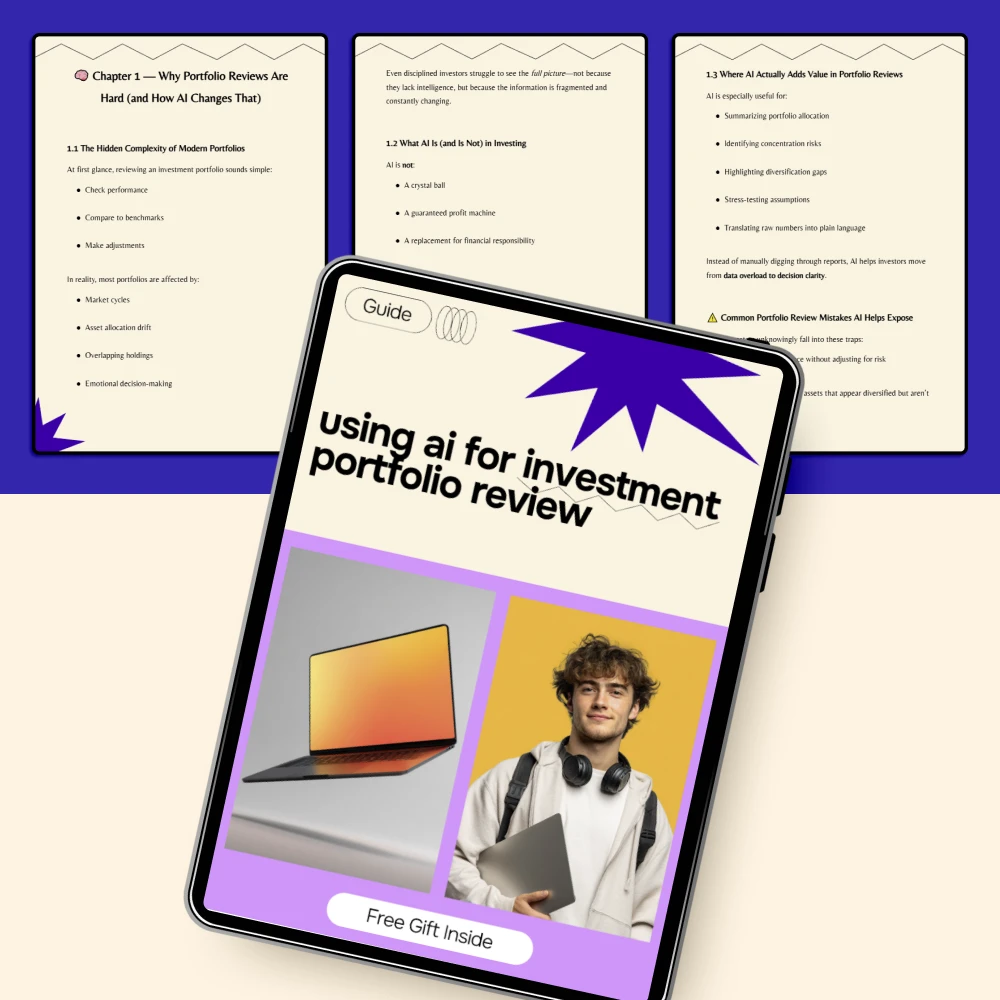
Reviewing your investments does not have to begin with a prediction about the market. A more useful starting point is understanding what you own, how your holdings fit together, and which questions deserve a closer look.
AI can help organize that work, but it cannot replace your judgment or personalized financial advice. Our team recommends treating it as a review assistant: give it a privacy-conscious snapshot, examine its response, and verify important details before making decisions.
What AI Can Help You Review
AI can turn a list of holdings into a clearer summary of asset allocation, such as the approximate percentages you hold in stocks, bonds, cash, and other assets. It can also suggest questions about concentration—for example, whether several funds hold many of the same companies.
That kind of review is different from asking AI to predict next year’s winners or guarantee a return. Markets are uncertain, and an AI response can sound confident even when its information or calculations are wrong. A useful question asks for an explanation or identifies gaps; it does not assume that an answer can eliminate risk.
For a practical starting point, our Using AI for Investment Portfolio Review guide is available for $7.99. It is a resource for investors who want to explore a more organized approach to AI-assisted reviews.
Prepare a Privacy-Conscious Portfolio Snapshot
Before you begin, gather a current list of your holdings and their approximate weights. Add the goals associated with the accounts, your time horizon, and any relevant fund or account fees. For example, you might describe a retirement portfolio as 60% stock funds, 30% bond funds, and 10% cash, then provide more detail about the funds if needed.
Remove names, account numbers, login credentials, and other identifying details. Use percentages rather than account balances where possible, and avoid sharing documents that contain personal information. Even an anonymized snapshot can reveal sensitive financial information, so share only what is necessary.
Check the AI tool’s privacy and data-handling settings before entering anything. Look for information about whether your inputs may be stored, used to improve the service, or shared. If you are uncomfortable with those terms, use a hypothetical portfolio instead.
Ask Better Questions About Your Portfolio
Start with questions that help you understand the portfolio rather than questions that demand a trade. You can ask AI to summarize allocation, identify possible overlaps, or explain what additional information would be needed for a fuller review. Specify that it should flag uncertainty instead of filling gaps with assumptions.
Portfolio Review Questions and Checks
| Review area | Example question for AI | Follow-up check |
|---|---|---|
| Allocation | Summarize these holdings by asset class and percentage. | Confirm the categories and calculations. |
| Concentration | Which holdings or sectors may create concentration risk? | Check fund holdings and overlapping exposures. |
| Fees | Explain how these listed fees could affect long-term costs. | Verify current expense ratios and account charges. |
| Risk | What questions should I ask about this portfolio’s risk? | Consider your goals, time horizon, and ability to withstand losses. |
When reviewing the response, remember that a fund’s name alone may not reveal all its underlying investments. Two different funds can overlap, and a single fund can contain a mixture of asset classes. Verify classifications and holdings using fund documents, and confirm calculations and current prices against reliable sources.
For background on how allocation and diversification work, see Investor.gov’s explanation of asset allocation and diversification. Diversification can help manage risk, but it does not guarantee that you will avoid losses.
Turn AI Output Into a Review Checklist
Once you have a response, separate factual claims from suggestions. A statement about a fund’s expense ratio is a claim you can check; a suggestion that you consider reducing an exposure is a question to evaluate in the context of your own circumstances.
Use a short checklist to keep the next steps manageable:
- Confirm the holdings, percentages, fees, and assumptions used in the review.
- Check whether any apparent concentration is real by examining underlying fund holdings.
- Compare potential concerns with your goals, time horizon, and tolerance for loss.
- Write down questions you cannot answer confidently before taking action.
A concern raised by AI does not automatically mean you should sell. Selling or rebalancing may create taxes, transaction fees, or other consequences, depending on the account and investment. A qualified financial or tax professional can help you assess those consequences when appropriate.
Be cautious of any service that uses AI claims to promise unusually high returns or pressure you into acting quickly. FINRA’s guidance on AI and investment fraud explains warning signs to watch for.
Explore the Guide
Our Using AI for Investment Portfolio Review guide, listed at $7.99, offers a practical resource for exploring this topic. Use it alongside your own research and the records available from your financial institutions.
If you are also interested in applying AI to travel planning, we offer the separate travel deals with AI digital ebook for $15.99. It addresses a different planning task and is not an investment resource.
These materials are for educational use. AI output is not personalized investment advice and cannot guarantee results.
FAQ
Can AI tell me whether my investment portfolio is right for me?
AI can summarize information and help you frame questions, but suitability depends on your goals, finances, time horizon, and tolerance for risk. A qualified financial professional can help you evaluate your circumstances.
What information should I avoid sharing with an AI tool?
Do not share login credentials, account numbers, names, or other identifying details. Use anonymized percentages where possible and check the tool’s privacy settings before sharing financial information.
How often should I use AI to review my portfolio?
Choose a consistent schedule that fits your goals, and consider another review after a meaningful life or portfolio change. Reviewing regularly does not mean you need to trade frequently.








Leave a comment